

How to Turn Meta Ads Into a Consistent Revenue Channel for Your Brand

Most brands treat Meta Ads as an experiment.
They boost a post, run a broad campaign, spend a few hundred pounds, see inconsistent results — and conclude that Meta Ads "don't work for them."
The problem isn't Meta. The problem is the approach.
Meta Ads, when built correctly, aren't a marketing tactic. They're a revenue channel — predictable, scalable, and measurable. The difference between brands that see 3x ROAS and brands that see 34x ROAS isn't budget. It's structure.
Here's what that structure actually looks like.
1. Build the Foundation Before You Spend a Penny
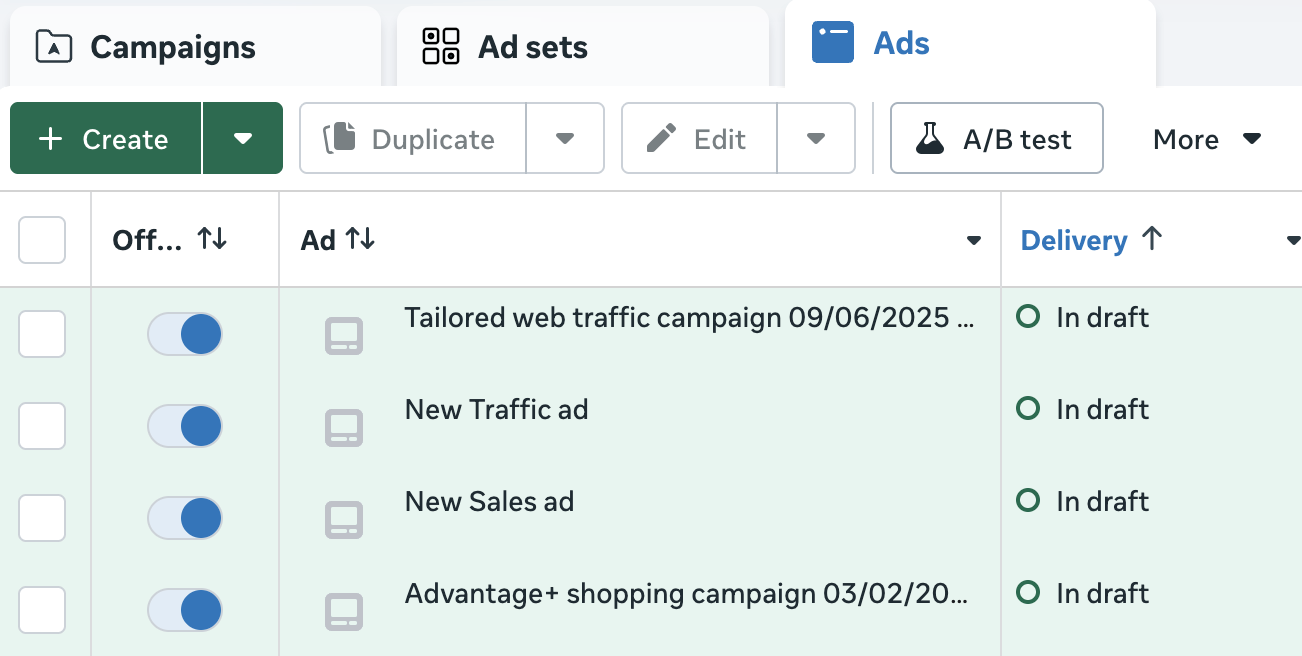
The most common Meta Ads mistake is launching campaigns before the infrastructure is ready.
If your website isn't optimised to convert paid traffic, you're paying to send people to a leaky bucket. Every pound spent on acquisition is wasted the moment a visitor lands on a slow page, a confusing product layout, or a checkout with unnecessary friction.
Before running a single campaign, you need:
Full Meta Pixel implementation — tracking every meaningful event (add to cart, checkout initiated, purchase)
Conversion-optimised landing pathways — clear product pages, frictionless checkout, strong value propositions
Revenue-based performance measurement — tracking actual revenue, not just clicks or impressions
When we partnered with Just Cornish — a brand launching into the premium Cornish food market with zero existing audience data — we built this foundation before touching the ad account. The result was nearly £25,000 in revenue across two controlled campaign windows, delivering a5x ROAS and 305% ROIfrom a standing start.
Infrastructure first. Traffic second.
2. Stop Running Ads. Start Building a System.
There's a fundamental difference between running ads and building a Meta revenue system.
Running ads means launching campaigns, hoping for results, and reacting to performance. Building a system means designing a structured framework with defined objectives, controlled testing, and rules-based scaling.
A structured Meta system includes:
Prospecting campaigns — finding new audiences who match your ideal customer profile
Creative testing matrix — systematically testing different ad formats, hooks, and offers to identify what converts
Layered retargeting — re-engaging people who have visited your site, engaged with your content, or abandoned checkout
Budget scaling tied to performance data — only increasing spend when the numbers justify it
This is exactly the framework we deployed for Colleton Great House, a luxury heritage retreat that had strong brand reputation but no structured paid acquisition system. With approximately £100 ad spend per country per month across three international territories, we generated around £10,000 in monthly booking revenue — delivering 18–23x ROAS and 1,700%+ ROI during high-performance windows.
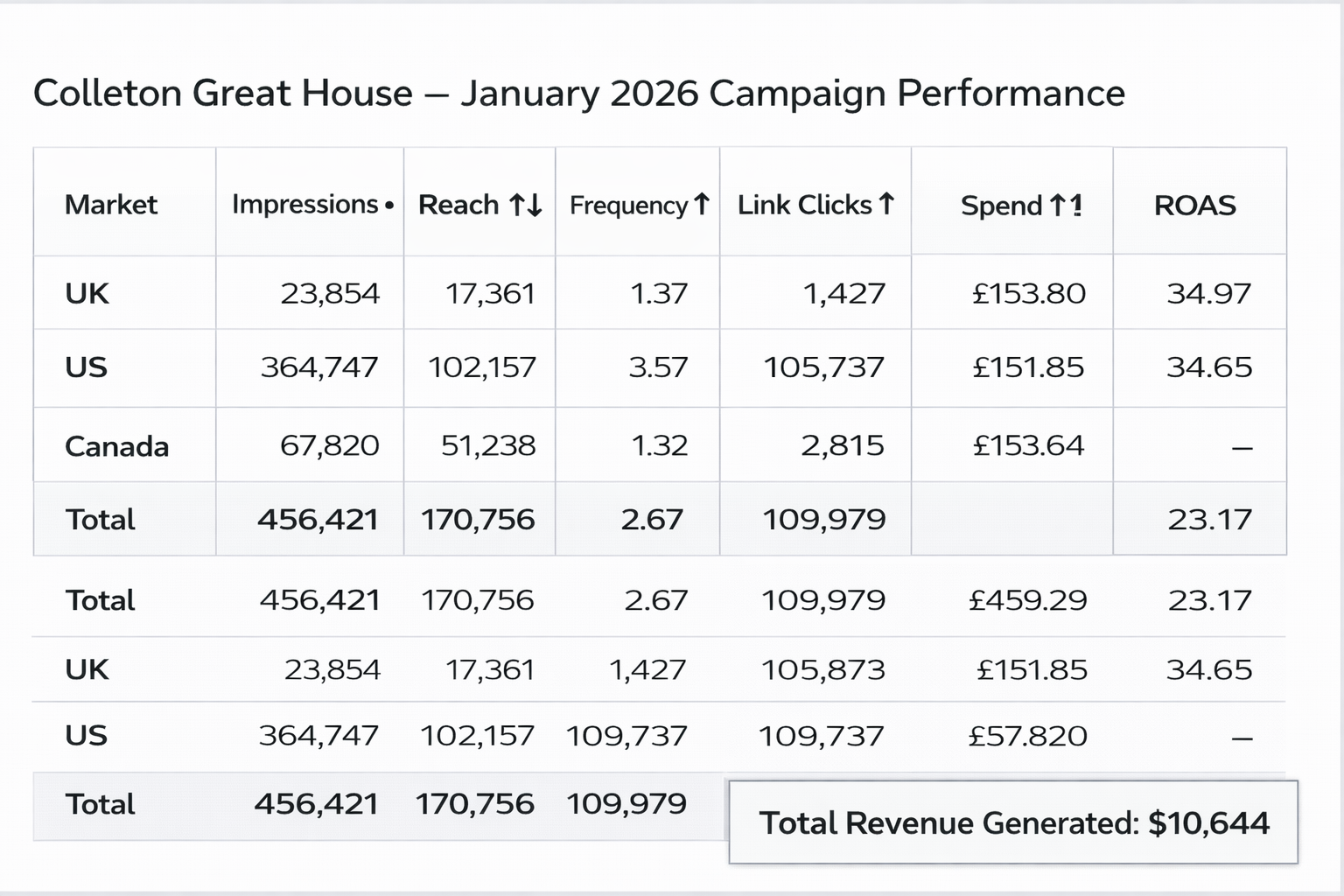
That kind of efficiency doesn't come from spending more. It comes from spending smarter.
3. Treat Creative as a Performance Variable
Most brands treat ad creative as a branding exercise. High-performing Meta advertisers treat it as a data point.
Every piece of creative — the image, the headline, the hook, the offer — is a variable that can be tested, measured, and optimised. Creative testing is not about making pretty ads. It's about identifying which combinations of message and format drive the lowest cost per acquisition and the highest return.
A structured creative testing cycle looks like this:
Launch multiple creative variations simultaneously
Measure performance against revenue metrics (not vanity metrics like reach or impressions)
Kill underperformers quickly
Scale winners with controlled budget increases
Continuously introduce new creative to prevent audience fatigue
This systematic approach is what separates consistent revenue performance from unpredictable results.
4. Don't Scale Spend — Scale Efficiency
One of the most damaging myths in paid media is that scaling means spending more.
Real scaling means improving efficiency first — lowering your cost per acquisition, increasing your average order value, improving your conversion rate — and then increasing spend on a system that you know works.
If your campaigns are generating a 2x ROAS, spending more will give you more of a 2x ROAS. If your campaigns are generating a 34x ROAS — a benchmark we recently achieved for a client — scaling spend multiplies that performance.
The sequence matters:
Build the infrastructure
Test and validate creative and audiences
Optimise conversion and AOV (average order value)
Scale spend based on proven performance data
Skip any of those steps and you're not scaling — you're gambling.
5. Connect Meta to Your Wider Revenue Ecosystem
Meta Ads don't operate in isolation. The most efficient Meta revenue systems are connected to the rest of your marketing infrastructure.
For e-commerce brands, this means:
Email capture built into paid traffic flow — every Meta visitor who doesn't convert immediately should enter a lifecycle email sequence
Retargeting aligned with email campaigns — so your paid and owned channels reinforce each other
Lifecycle messaging that monetises your existing audience — reducing your dependency on paid acquisition for every sale
For The Cornish Larder, aligning social strategy and email activation with structured conversion systems drove a 98.86% year-on-year revenue increase. For Devon Hampers, implementing structured marketing systems across acquisition, conversion, and monetisation delivered 152% year-on-year growth in marketing-driven revenue.
Paid acquisition brings people in.
Your wider revenue ecosystem keeps them converting.
The Bottom Line
Meta Ads work. They work extraordinarily well — for brands that approach them as revenue infrastructure, not as a series of boosted posts and hopeful experiments.
The brands that consistently generate strong ROAS aren't spending more. They're building better systems.
If your Meta Ads feel unpredictable, inconsistent, or like they're just burning budget — the answer isn't to stop. The answer is to build the system properly.
At JamFirst, we build structured Meta Ads revenue systems for e-commerce and hospitality brands ready to scale predictable growth. Book a free growth strategy audit and we'll identify exactly where your current performance is leaking — and how to fix it.
